Image Compression, Restoration, and Recognition
Ren Shibata: End-to-End Learning of Image Compression-Restoration and Recognition Models
Overview
Edge computing-based image recognition systems face the challenge of increased network load as communication volume grows, leading to reduced network speeds. While an approach using compressed and restored images for recognition has been proposed to reduce communication volume, it has been reported that the recognition accuracy decreases compared to using uncompressed images. In this study, we propose a framework for end-to-end learning of image compression-restoration and recognition models. By jointly training two different models in an end-to-end manner, our proposed method prevents the loss of essential information during image compression and restoration, enabling high-accuracy image recognition.
Proposed Method
Proposal of Image Compression-Restoration and Recognition Framework
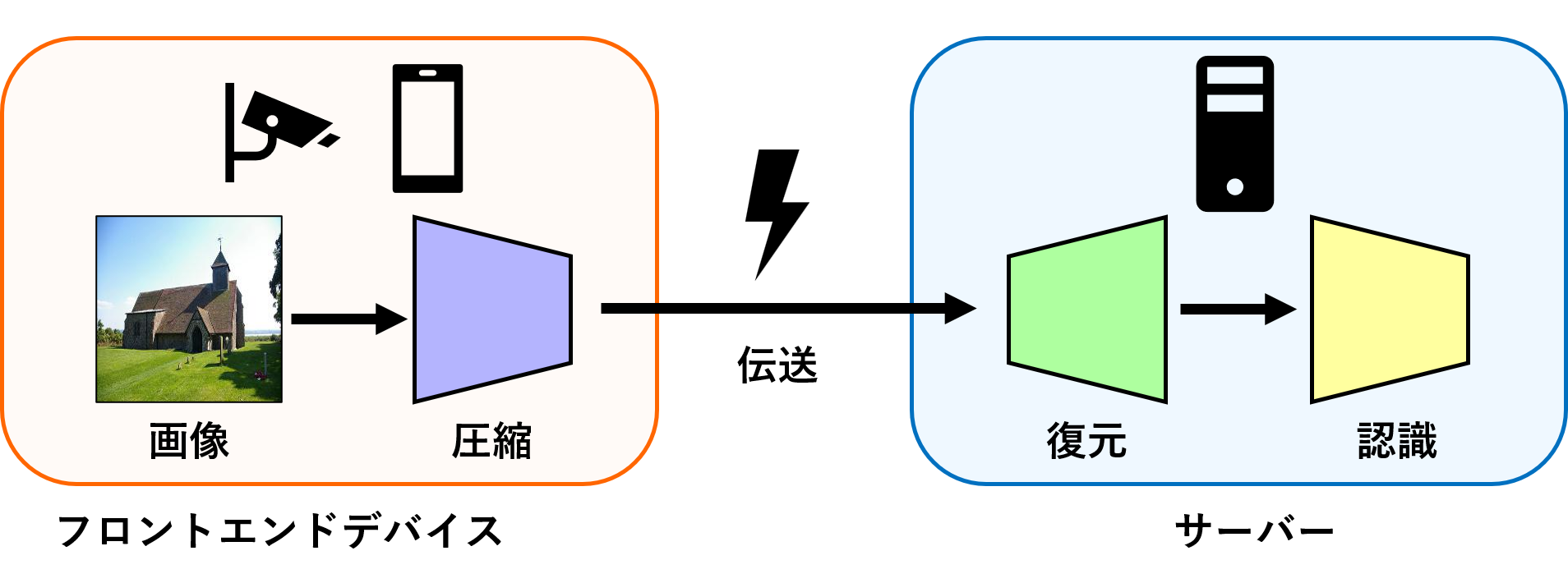
This study proposes a framework that integrates an image compression-restoration model with a recognition model. By transmitting compressed information encoded on the frontend device, the system achieves fast and low-latency data communication. The compressed data is then decoded on the server-side and subsequently recognized using a deep learning model.
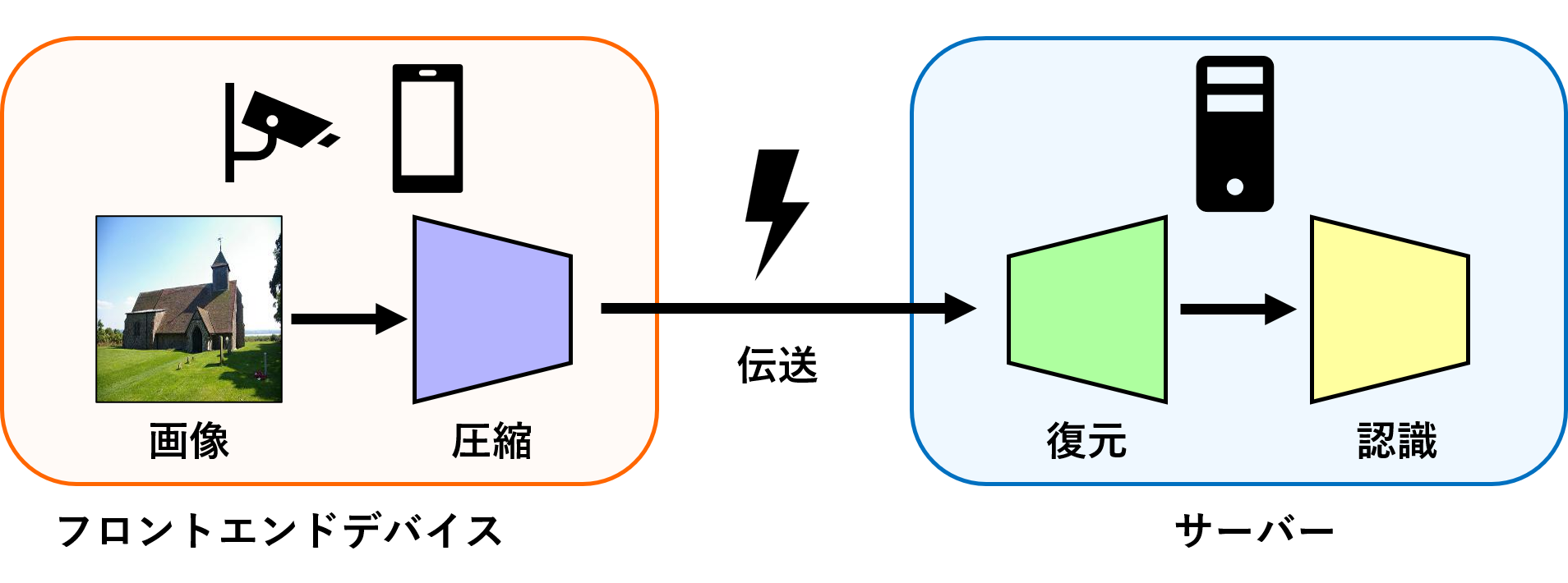
Proposed Framework
Image Compression-Restoration Model
The image compression-restoration model adopts a recurrent neural network (RNN)-based recursive autoencoder. The model first outputs the difference between the restored image and the input image in a single step, which is then re-input to the autoencoder. This process is repeated recursively, and the multiple restored images obtained are combined to produce the final output. By controlling the number of iterations, the quality of the output image can be adjusted.
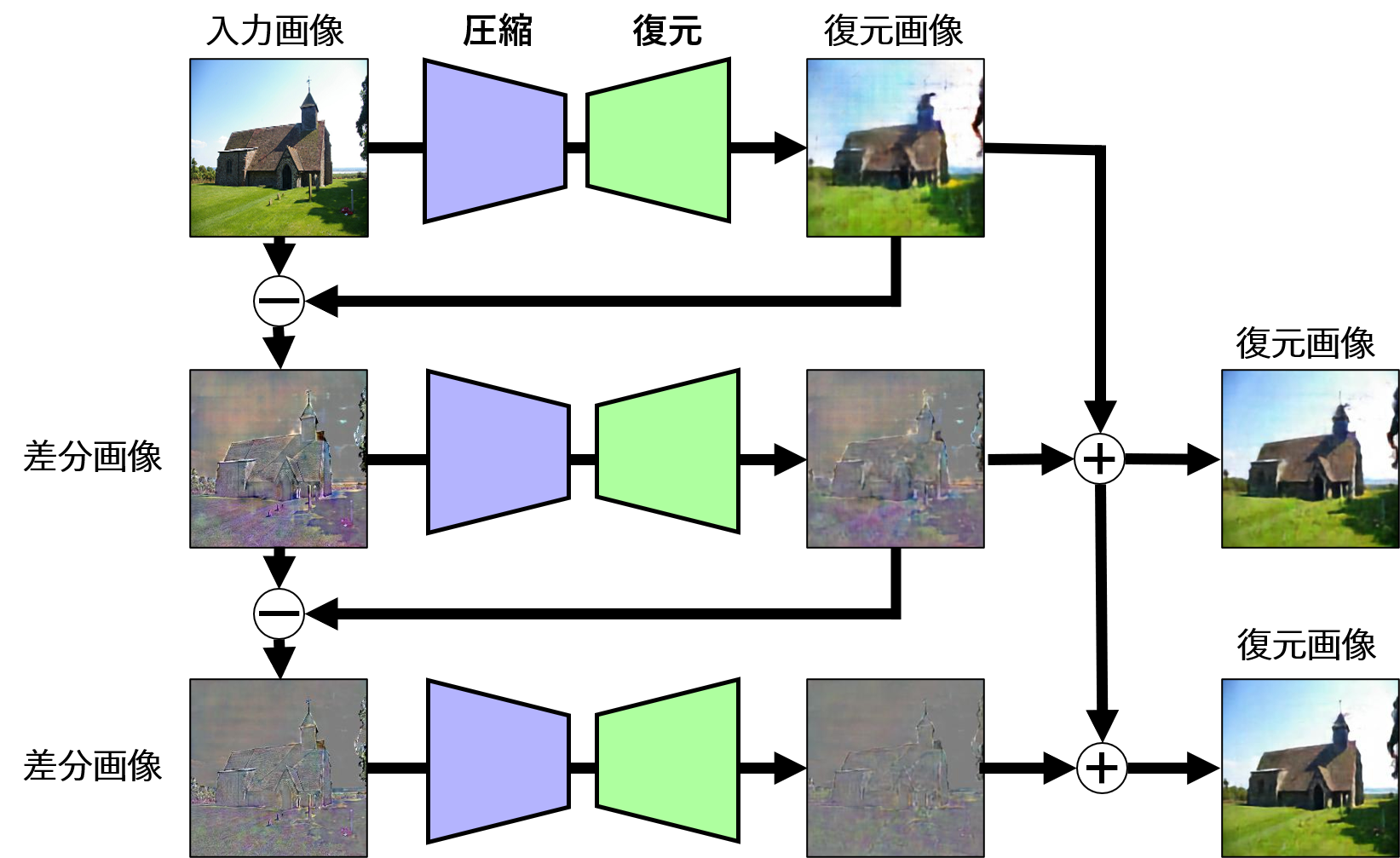
Overview of Recursive Autoencoder
End-to-End Learning of Compression-Restoration and Recognition Models
The compression-restoration and recognition models are trained in an end-to-end manner. The compression-restoration model prioritizes compressing information essential for recognition while suppressing noise that hinders recognition. This enables the recognition model to achieve high-accuracy recognition based on images output from the compression-restoration model.
Evaluation Experiments and Results
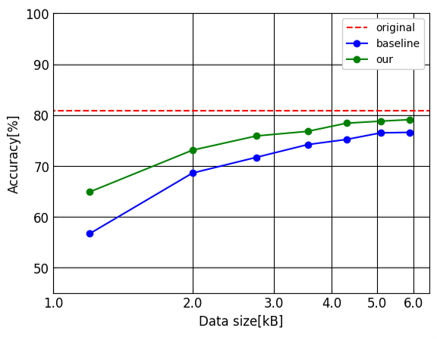
We evaluated performance using an image classification task with ImageNet-100. After individually optimizing the compression-restoration and recognition models, we combined them into a single framework and compared them. The proposed method achieved recognition accuracy improvements of 2.3–8.2% compared to separate optimizations. Additionally, it achieved up to 98.8% compression of data volume compared to uncompressed images.
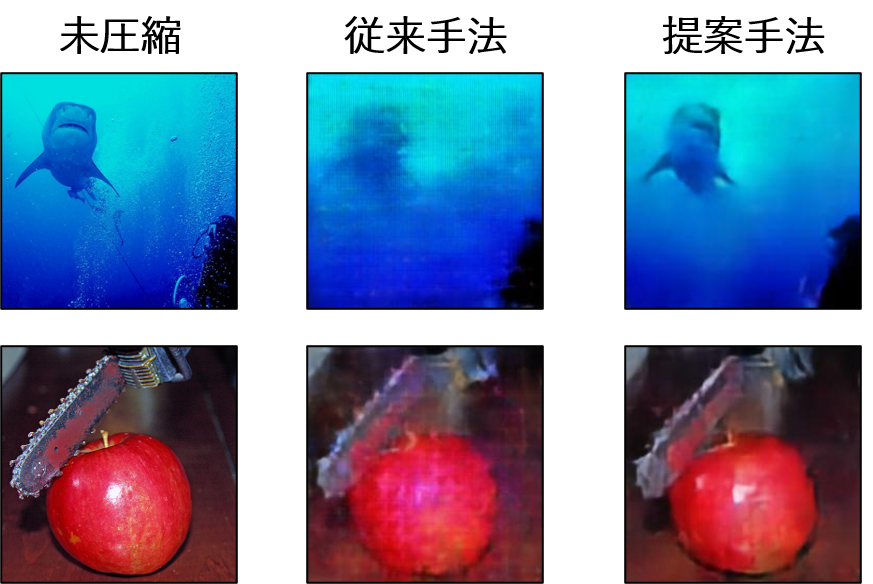
Image Recognition Accuracy
Compressed-Restored Images
A comparison of compressed-restored images between conventional and proposed methods showed that the proposed method effectively suppressed noise.
Examples of Compressed-Restored Images
Related Publications
— Ren Shibata, Yuji Yamauchi, “End-to-End Learning Framework Incorporating Image Reconstruction and Recognition Models”, IEEE Access, vol. 13, pp.73355 - 73361, 2025. link