Deepfake Detection
Toshiki Takase: Enhancing Deepfake Detection Accuracy with Wavelet Vision Transformer and Self-Supervised Learning
Overview
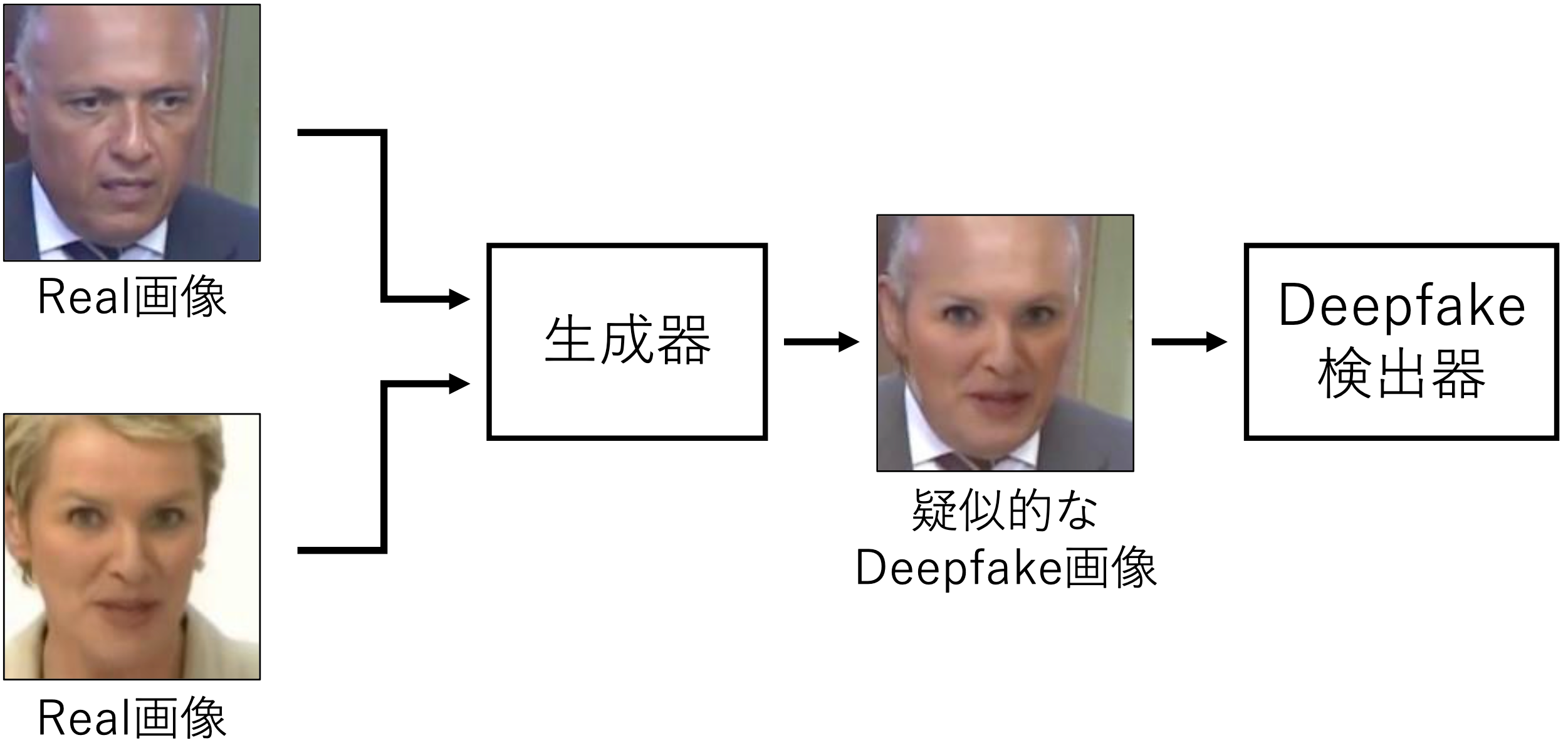
In recent years, Deepfake technology, which allows AI to skillfully synthesize and manipulate facial images, has been evolving rapidly. Cases of misuse on social media and other media platforms are also increasing. Given this background, there is a strong demand for developing technology that can automatically detect Deepfake images with high accuracy.
In this study, we propose a new approach to Deepfake detection by combining Wavelet Vision Transformer (Wave-ViT) with Self-Supervised Learning and validate its effectiveness.
Proposed Method
Introduction of Wavelet Vision Transformer (Wave-ViT)
Conventional Vision Transformers (ViTs) excel at capturing the overall structure of images. However, they struggle to extract high-frequency components (such as edges and noise) effectively, which makes their performance inferior to CNNs in Deepfake detection.
To address this issue, our study adopts Wave-ViT, which incorporates wavelet transform capable of decomposing images into frequency components. This allows the model to effectively capture high-frequency forgery artifacts commonly found in Deepfake images.
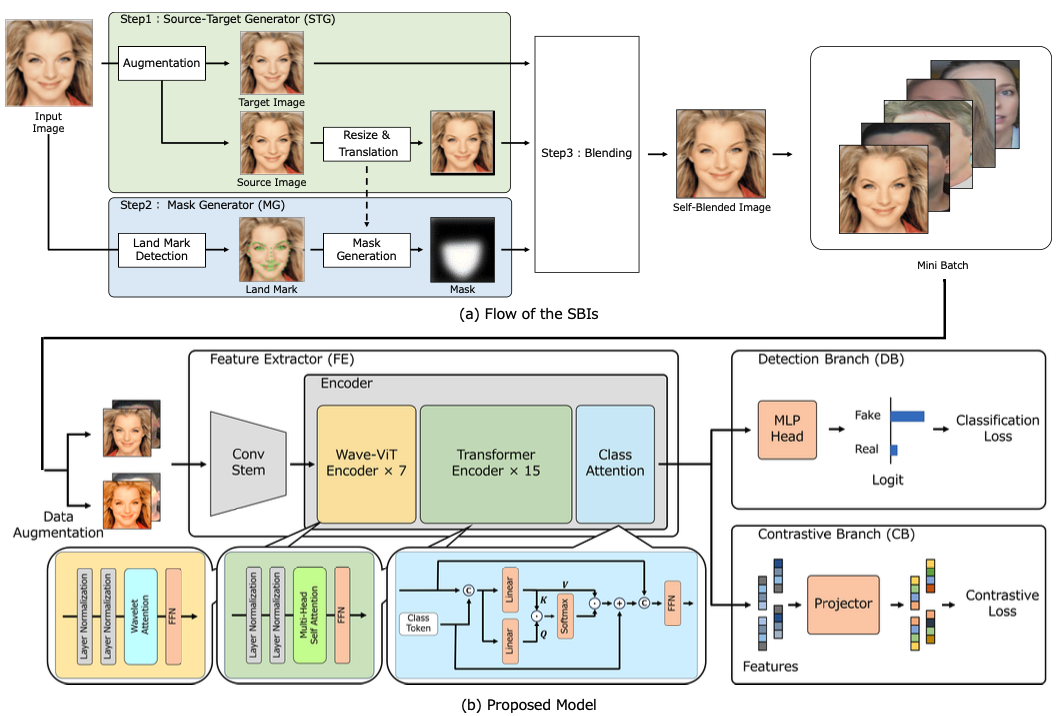
Proposed Method Workflow
Introduction of Self-Supervised Learning (SimCLR)
To learn fine-grained differences between Deepfake and natural images, we integrate SimCLR, a self-supervised learning technique.
In this learning approach, different augmentations are applied to the same image to create a “positive pair,” while unrelated images are treated as “negative pairs.” This enables effective feature extraction without using labeled data, enhancing the model’s ability to distinguish Deepfakes.
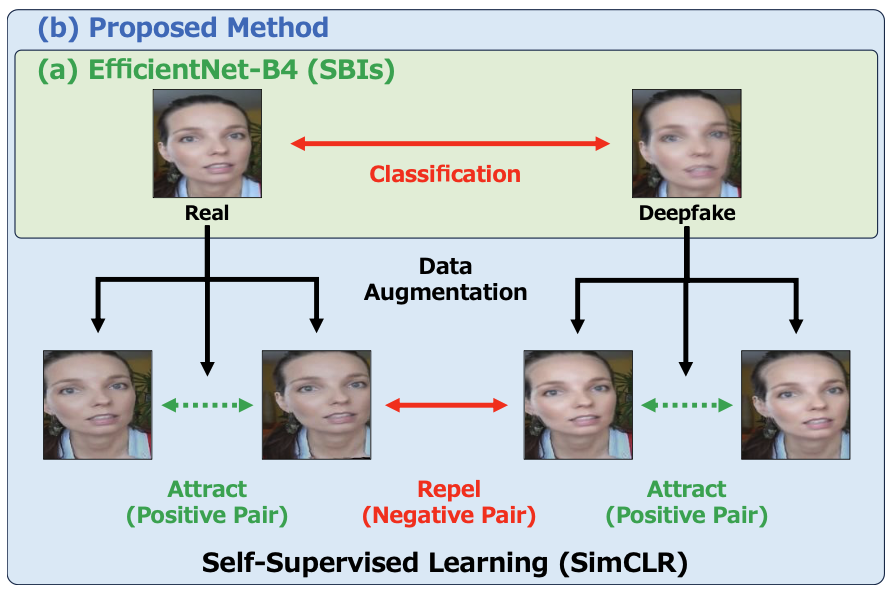
Proposed Method Workflow
Data Augmentation Using Self-Blended Images (SBIs)
To expand the training dataset, we generate pseudo-Deepfake images using a method called “Self-Blended Images (SBIs).” This allows the model to learn from a more diverse range of forgery artifacts, improving generalization performance.
Evaluation Experiments and Results
Comparison experiments using multiple benchmark datasets, including FaceForensics++, demonstrate that our proposed method improves the average AUC (Area Under Curve) by 2.44% compared to conventional CNN-based approaches such as EfficientNet-B4.
| Method | Average AUC (%) |
|---|---|
| EfficientNet-B4 | 90.95 |
| ResNet-50 | 88.25 |
| ViT | 83.33 |
| Wave-ViT | 88.84 |
| Proposed Method | 93.39 |
Attention to Forgery Artifacts
Visualization of attention maps confirms that our proposed method effectively focuses on key forgery artifacts, such as boundaries in Deepfake images, where tampering signs are often present.
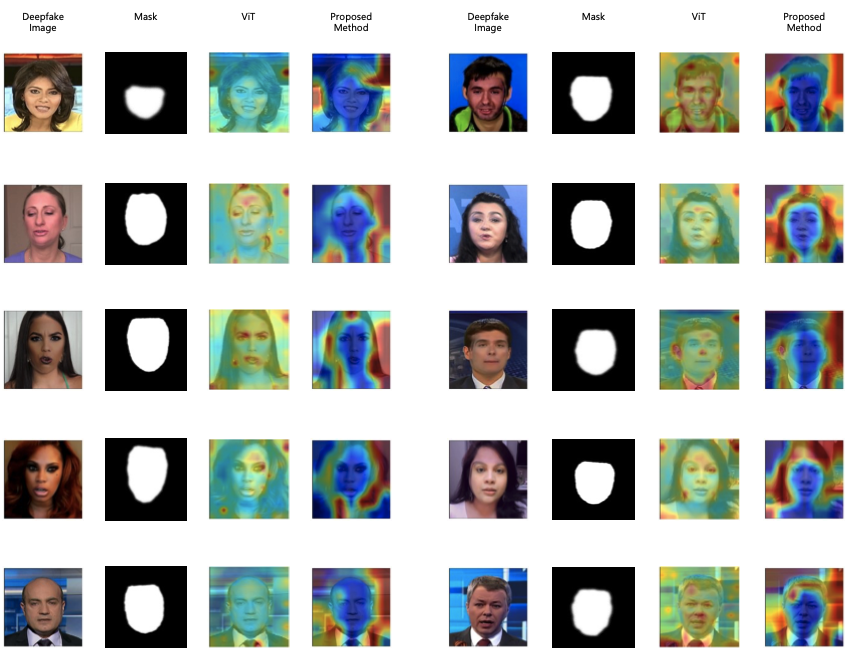
Visualization of Attention Maps
Related Publications
— Toshiki Takase, Yuji Yamauchi, “Enhancing Deepfake Detection Accuracy with Wavelet Vision Transformer and Self-Supervised Learning,” Journal of Precision Engineering, vol. 91, no.2, pp.156-162, 2025. link